Powder Coating System Design for Fire Pipelines
Fire pipelines are rarely noticed—until the moment they are needed most. In factories, warehouses, and public buildings, these steel pipes are expected to perform flawlessly after years of exposure to humidity, dust, and mechanical wear. A single weak point in the coating can become a source of corrosion, leakage, or failure over time.
This is why coating fire pipelines is not just about appearance or throughput. It is about long-term protection and responsibility. A properly designed powder coating system must deliver uniform thickness, strong adhesion, and repeatable quality across pipes of varying lengths and diameters. More importantly, it must do so consistently, day after day, under real production conditions.
Coating Requirements Unique to Fire Pipelines
Fire pipelines operate in environments that are far less forgiving than they appear. Even when installed indoors, they are constantly exposed to moisture, temperature changes, and airborne contaminants. Over time, these conditions test not only the coating material itself, but also how well it was applied in the first place.
One of the key challenges lies in coating thickness and adhesion. Fire pipelines often require a consistent, relatively thick powder layer to ensure corrosion resistance over many years of service. Any variation—thin spots, poor edge coverage, or weak adhesion—can accelerate rust formation, especially around joints and welded areas. Unlike decorative parts, these defects are not immediately visible, but their consequences can be severe.
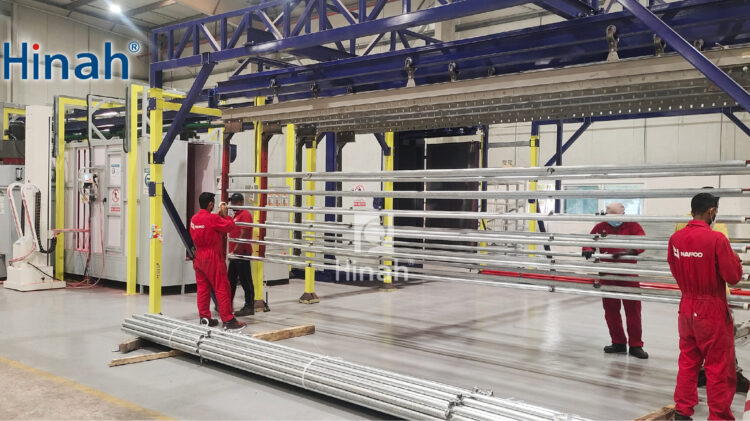
Another factor is geometry. Fire pipelines are long, cylindrical, and often heavy. Their length and weight place high demands on handling stability during coating. If a pipe shifts, rotates unpredictably, or vibrates while passing through the spray zone, uniform coverage becomes difficult to achieve. This is where many general-purpose powder coating lines begin to struggle.
Finally, production consistency cannot be ignored. Fire pipeline manufacturers typically run large batches with similar specifications, expecting repeatable results across hundreds or thousands of pieces. Meeting this expectation requires more than skilled operators—it depends on whether the powder coating system is designed to handle pipe dimensions, throughput, and coating requirements as a complete, coordinated process.
Key Design Principles of Powder Coating System for Fire Pipelines
Designing a powder coating system for fire pipelines starts long before equipment selection. The first and most important question is not how fast the line should run, but how the pipes will move through the process—steadily, predictably, and without interruption. Fire pipelines are heavy and elongated, and any instability during transfer will directly affect coating uniformity.
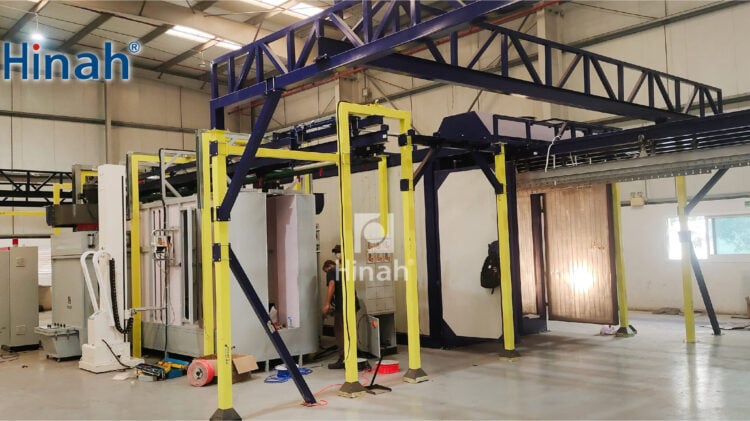
System layout must be built around pipe length and spacing. Sufficient clearance is needed not only inside the powder coating booth, but also at every transition point where pipes enter or exit each process stage. Tight layouts may save floor space, but they often create handling compromises that lead to uneven coating or operator intervention later on.
Flow type is another critical decision. While batch systems may work for small volumes or mixed products, fire pipeline production usually benefits from a continuous powder coating system. Continuous flow reduces stop-and-go movement, stabilizes electrostatic conditions during spraying, and supports more consistent film build across long runs. The result is not just higher throughput, but more repeatable coating quality.
Equally important is balance. A powder coating system must be designed so that pretreatment capacity, spray booth performance, and curing time are aligned with each other. Oversizing one section while underestimating another often leads to bottlenecks, forced speed adjustments, or incomplete curing. In real production, these imbalances are where coating defects quietly begin.
Conclusion
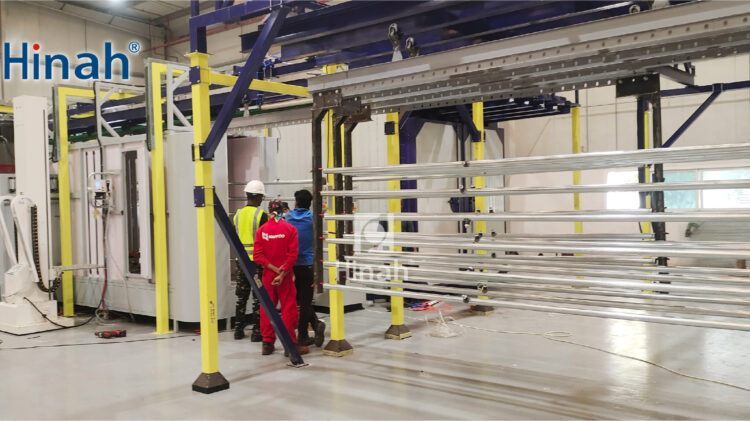
Fire pipelines are not decorative components—they are part of a safety system that must remain reliable over decades of service. For this reason, coating quality cannot depend on operator experience or temporary adjustments. It depends on whether the powder coating system is designed specifically for the realities of long, heavy pipes and continuous production.
A purpose-built powder coating system brings stability to every stage of the process, from handling and spraying to curing and throughput control. When these elements are properly aligned, coating consistency improves, rework is reduced, and long-term corrosion protection becomes predictable rather than uncertain. For fire pipeline manufacturers, thoughtful system design is not an upgrade—it is a requirement for dependable performance.