Powder Coating Line Project in Jordan: Transformers on a Power and Free Conveyor
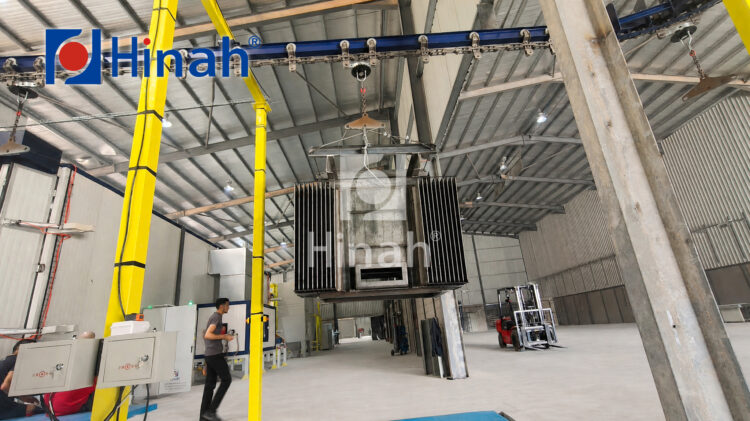
A transformer powder coating line in Jordan is not built for speed. It is built for stopping in the right place. A loaded carrier can wait while the line behind it keeps moving. That is why this project runs on a power and free conveyor instead of a monorail. On parts this heavy, that single ability decides the whole layout.
Why does a transformer powder coating line need accumulation?
Coating a transformer is four processes with four different rhythms. A crane sets the pace at loading. The washer runs in batches. The booth wants a steady pass at constant speed. The oven wants a full load before the burner ramps up.
A monorail chains all four to one speed. A power and free conveyor separates them. Carriers leave the chain, wait in a buffer, then rejoin. Nothing else in the line changes the economics as much.
| Requirement | Monorail | Power and free |
|---|---|---|
| One speed for the whole line | Yes | No, each carrier can stop |
| Buffer between processes | Not possible | Built in |
| Parts in the tonne range | Limited by chain pull | Carried on independent carriers |
| Repair loop or manual touch-up | Stops the line | Carrier leaves and rejoins |
We compared the two drive types in more detail in a separate article on power and free versus monorail conveyor.
What changes when a single part weighs a few tonnes?
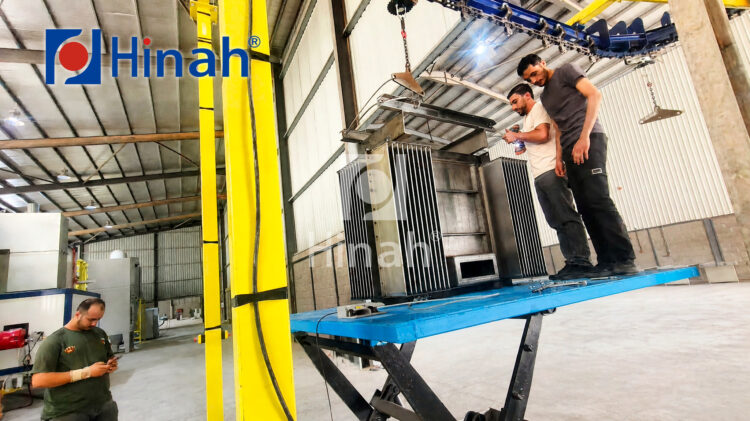
Everything that touches the part changes. On a transformer powder coating line the hanger stops being a consumable. It becomes a load-bearing part: welded frames, load-rated pins, a heavier rail profile, closer supports. Drop sections move to the loading bay so the crane never reaches across the washer.
Two details bite late. The floor is one: a loaded carrier puts its weight on four small points, and a thin slab shows that within a year. Grounding is the other. Paint builds on hooks, contact resistance rises, and transfer efficiency falls long before anyone sees a finish problem.
Where should the buffer zones sit between pretreatment, booth and cure?
Two places earn their cost on a transformer powder coating line, and only two.
The first sits after dry-off, ahead of the booth. The washer releases a batch while the booth wants single parts at a fixed speed. Without that buffer, the operator either runs the booth empty or pushes parts through too fast.
The second sits before the cure oven. Powder does not care how fast parts arrive, but the oven does. A half load wastes a ramp cycle, while a short queue lets you fill the chamber and close the door once.
Size both by the crane cycle and the oven load. Line speed is an output of those two, not an input. A transformer powder coating line that gets this wrong buys conveyor it never uses.
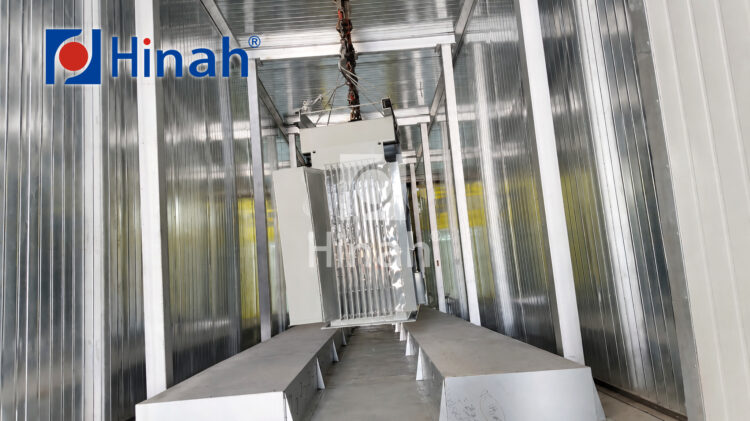
How does Jordan’s dust and heat change the coating system?
Dust is the harder problem. It settles on a wet part between stages and shows up as a speck under the film. Closed pretreatment, filtered booth air and a dry-off that actually dries the part help more than any additive.
Heat and UV drive the powder choice. An exterior-grade polyester holds gloss and colour longer than an interior grade, and storage matters more than most plants expect. A container left in the sun through a Jordanian summer will block in the hopper.
Aqaba and Amman are not the same job. Coastal humidity and inland dust attack a coating in different ways, so the corrosion category should follow the installation site rather than the country.
What film build and edge coverage does a transformer powder coating line need?
Film build follows the corrosion category in ISO 12944-5, not habit. Once you fix the category and the durability class, the thickness is a consequence. Deciding it after the layout is backwards, because film thickness changes booth time and oven time.
Coverage fails at edges first. Welds, cut edges, bolt holes and radiator fins take less powder than flat plate, and they are exactly where corrosion starts. Measure dry film thickness on the flat areas per ISO 19840, then look at the edges with your own eyes. An average that passes can still hide a thin edge.
How do you hang a transformer for even coverage on all four sides?
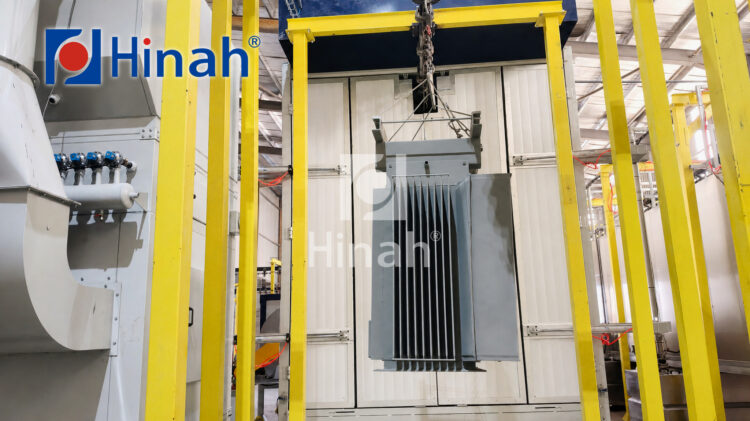
Hang from the lifting lugs, on two points. A single point lets the tank swing every time the carrier accelerates.
Rotation at the booth beats adding guns. A carrier that turns ninety degrees in front of the booth reaches the two faces a fixed hanger always misses.
Then the masking list: bushings, tap links, nameplate, earth pads and machined faces stay bare. Every item on that list costs time at loading, so freeze it before you design the hanger, not after.
Which tests should the contract specify?
Four at minimum. Adhesion by ISO 2409, salt spray by ISO 9227 or ASTM B117, dry film thickness by ISO 19840, impact resistance by ASTM D2794.
The pass values belong to the corrosion category you selected. Write them into the contract for the transformer powder coating line before the first panel runs through it. Arguing about salt spray hours after the line ships is a conversation nobody wins.
What would we design differently on the next transformer powder coating line?
– Freeze the masking list in the first week. It sets hanger geometry, booth time and labour, and it is the last item anyone wants to reopen.
– Give the hooks a cleaning station inside the loop. Coating builds, contact resistance climbs, and transfer efficiency drops without a single alarm.
– Keep the drop sections out of the oven. Heat plus a heavy carrier equals maintenance you do not need.
– And settle the corrosion category before the layout, because every metre of buffer and every minute of oven time follows from it.
Conclusion
A transformer powder coating line succeeds on details that never appear in a quotation: buffer placement, hanger contact, edge coverage. Get those right in Jordan’s dust and heat, and the same design travels well to the next transformer project.
The same suspension and buffer logic carries over to a busbar powder coating line, where the parts are long instead of heavy.