Large Electrical Cabinets Need More Than a Bigger Powder Coating Line
Large electrical control cabinets look straightforward from the outside. In production, however, their size and structure create several challenges that a standard coating setup may not handle well. A larger cabinet does not simply require a longer conveyor or a larger curing oven. Its dimensions, weight, surface geometry, door structure, and production volume all affect how the entire powder coating line should work. If the line design only focuses on fitting the cabinet inside the equipment, problems can appear later in pretreatment, spraying, conveying, and curing.
For large electrical cabinets, the better approach is to start with the workpiece and build the coating process around it.
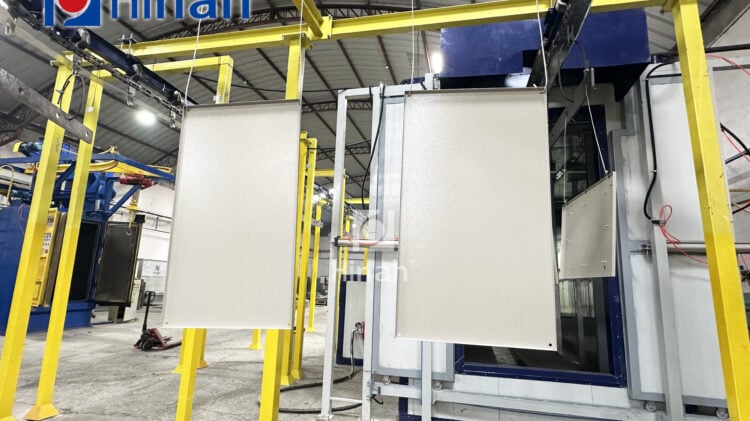
Why Large Cabinets Change the Coating Process?
The first issue is usually the cabinet itself.
Large cabinets often have deep bodies, doors, internal mounting structures, folded edges, reinforcement ribs, and narrow corners. These features create different spray distances and different powder deposition conditions across the same workpiece.
The cabinet size also affects how it moves through the line. A large door can swing or move if the hanger arrangement does not provide enough stability. A heavy cabinet can also create excessive movement on the conveyor, which makes automatic spraying less consistent.
For this reason, the useful working dimensions of the line matter more than the overall footprint of the equipment.
A good design should consider:
- Maximum cabinet length, width, height, and weight
- Door and panel dimensions
- Required hanging position
- Distance between workpieces
- Conveyor speed
- Production volume
- Powder color and change frequency
- Required film thickness
- Curing temperature and time
These factors should work together rather than being considered separately.
Powder Coating Line Design Starts With the Cabinet
For large electrical cabinets, the conveyor deserves particular attention.
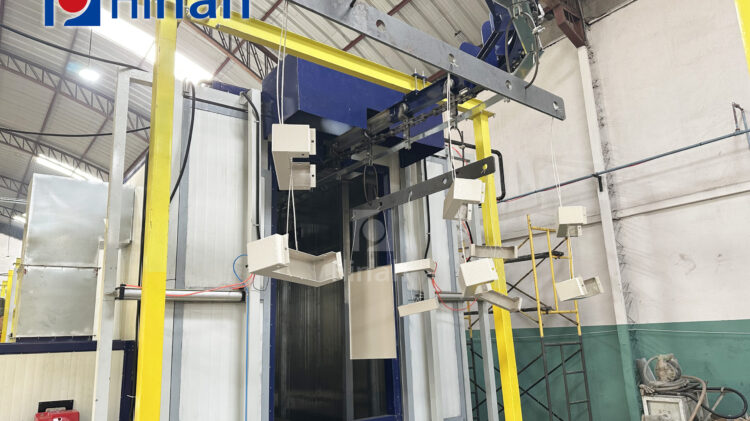
A conventional monorail arrangement may work well for smaller products, but large cabinets can require more stable transportation and better control of workpiece orientation. The hanger must support the load without creating excessive movement, while the conveyor needs enough clearance around corners, booths, ovens, and inspection areas.
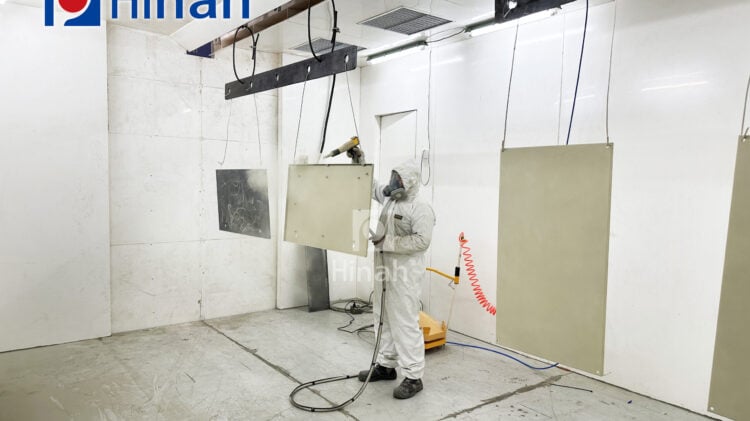
The spray booth also needs careful planning. A large cabinet takes up more booth space, but simply increasing booth dimensions does not solve every spraying problem. The gun arrangement, gun-to-workpiece distance, reciprocator movement, and cabinet geometry all influence powder coverage.
Deep cabinet sections deserve special attention. Automatic guns may reach the outside surfaces easily while struggling with recessed areas or internal edges. In some applications, operators may need to handle specific areas manually after automatic spraying.
This hybrid approach can provide better results than forcing every surface into a fully automatic process.
Pretreatment Is Where Many Problems Begin
Powder coating quality starts well before powder reaches the cabinet.
Large electrical cabinets often use cold-rolled steel, galvanized components, or different metal parts within the same assembly. Surface preparation must match the substrate and the required corrosion protection.
The pretreatment section should provide consistent cleaning, rinsing, and surface conditioning. Large panels also require sufficient spray coverage. If the spray pattern cannot reach recessed areas or internal surfaces, contaminants may remain even though the outside looks clean.
Drainage matters as well. Cabinet bodies and folded panels can hold pretreatment liquid if the design does not allow proper drainage. That residual liquid can affect the following stages and create quality problems later.
So when planning a powder coating line, pretreatment should receive the same attention as the powder coating booth and curing oven.
The Powder Curing Oven Is Not Just About Getting Bigger
Curing large electrical cabinets creates another important challenge.
A cabinet may have a large external surface but relatively low thermal mass, while another design may contain heavy reinforcement parts. Their heating behavior can differ significantly.
The target curing condition depends on the powder specification and the actual metal temperature, not simply the air temperature inside the oven.
A properly designed oven should provide stable temperature distribution and enough effective heating time for the largest workpieces. Conveyor speed, oven length, heat circulation, loading density, and cabinet arrangement all influence the result.
If production includes several cabinet sizes, the process should account for the largest and most thermally demanding products rather than using one setting for everything.
Powder Coating Line Capacity Is More Than Conveyor Speed
It is tempting to judge a powder coating line by its conveyor speed. That number alone tells very little.
For cabinet production, the real capacity depends on the complete process. Pretreatment must keep up with spraying. Spraying must keep up with curing. Loading and unloading must not create a bottleneck.
Workpiece spacing also matters. Large cabinets naturally require more distance between pieces, which reduces the number of units that can enter the system within a given period.
This is why production planning should start with the required output and work backward through each section of the line.
For example, if the production target requires frequent loading but the oven needs a long curing period, increasing conveyor speed may not solve the problem. The oven could become the limiting section instead.
Color Changes Deserve Attention in Cabinet Production
Many electrical cabinet projects involve several colors, especially when different customers or product series require different finishes.
Frequent color changes can affect both production rhythm and powder recovery. The booth, guns, hoses, recovery equipment, and areas around the spraying zone need a practical cleaning strategy.
A powder coating line designed for frequent color changes may use a quick-clean booth, separated recovery arrangements, or other configurations that reduce residual powder between colors.
The right choice depends on the number of colors, batch size, powder type, and production schedule. A line designed for one high-volume color should not follow the same logic as a line handling many small batches.
Build the Line Around the Real Production
Large electrical cabinets expose weaknesses in coating systems very quickly. Their size makes conveyor stability important. Their geometry makes powder coverage more demanding. Their surface area makes curing consistency critical. Their production volume makes every bottleneck easier to notice.
That is why a successful powder coating line should not be treated as a collection of oversized machines.
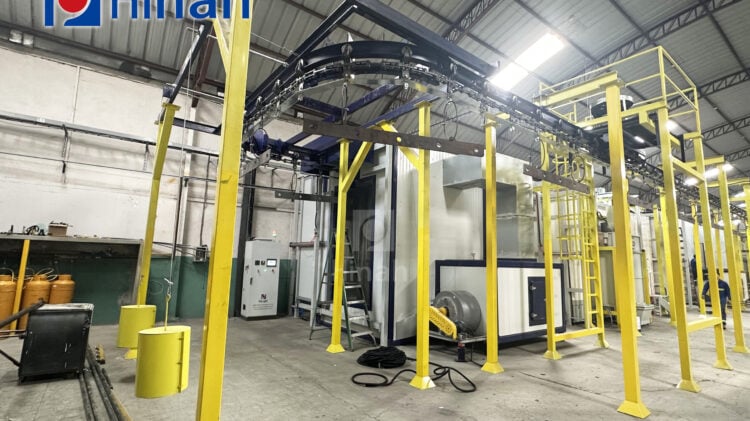
The better approach is to connect the workpiece, pretreatment, conveying, spraying, recovery, curing, and production rhythm into one process. Once those relationships are clear, equipment dimensions become much easier to determine.
For large electrical control cabinets, the goal is not simply to build a bigger line. It is to build a line that understands the cabinet.