Why Choosing Power and Free Conveyor System Instead of Monorail Conveyor?
If your coating line needs to stop some workpieces while others keep moving, a monorail conveyor may not be the right choice. Many production lines start with a simple conveyor system, but problems appear when they handle different products, longer curing times, or multiple coating processes.
A power and free conveyor system solves this challenge by allowing each carrier to move independently. Some workpieces can stay at a specific station for treatment, while others continue to the next process. This makes the material flow more flexible and helps coating lines handle more complex production requirements.
So, when should you choose a power and free conveyor system instead of a monorail conveyor?
Monorail Conveyor vs. Power and Free Conveyor System
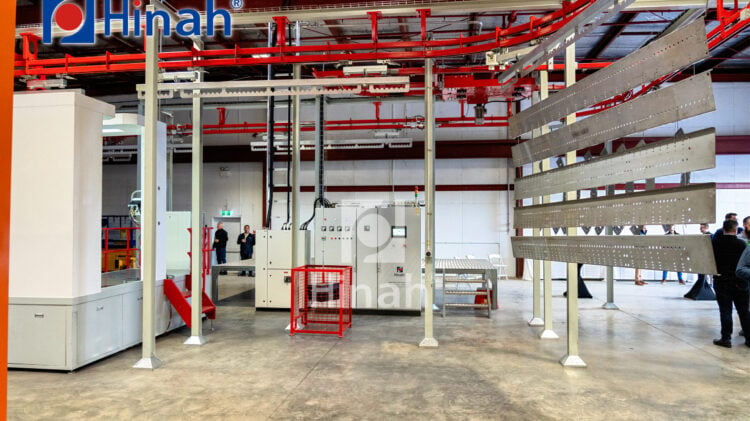
A monorail conveyor is designed for continuous transportation. All carriers follow the same track and usually move at a fixed speed. This structure works well when products have similar sizes and follow the same production route.
However, coating processes are often more complicated than simple transportation. A workpiece may need extra time for pretreatment, drying, curing, inspection, or manual operation. When every carrier moves together, one delayed process can affect the entire production flow.
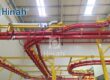
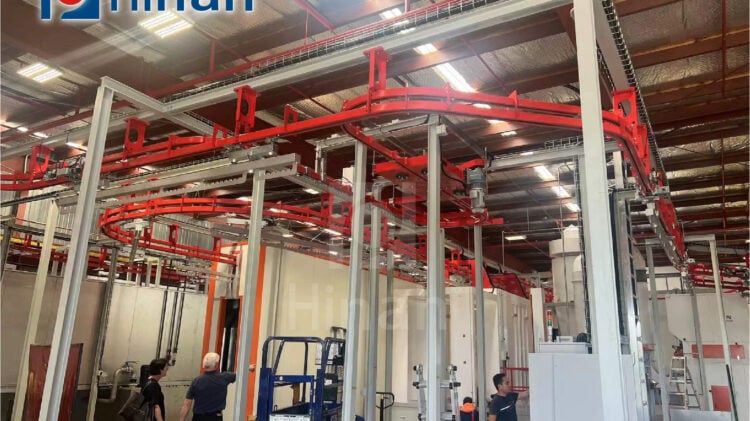
A power and free conveyor system uses two tracks to separate the driving movement from carrier movement. The power track moves the chain, while the free track carries the workpieces. Because carriers can be controlled individually, they can stop, accumulate, or move forward when required.
This difference gives coating lines more flexibility during production.
Why Is Power and Free Conveyor System Suitable for Coating Lines?
A coating line is not always a straight and continuous process. Different stages have different requirements.
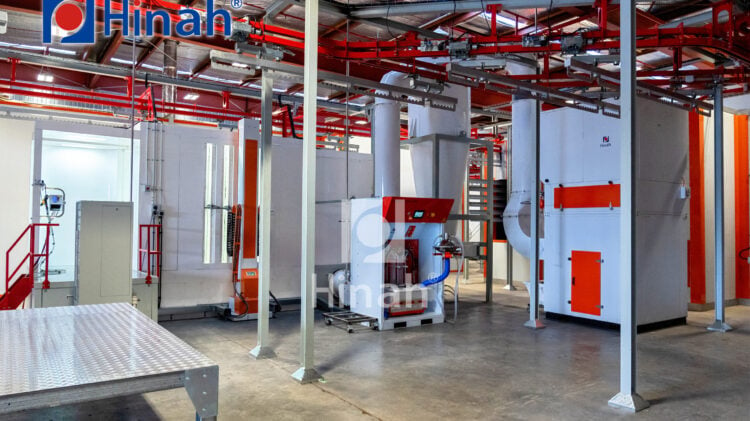
For example, a powder coating line may include loading, pretreatment, drying, spraying, curing, cooling, and unloading. Each stage requires a certain processing time. If all products move at the same speed, some areas may become overloaded while others wait.
A power and free conveyor system helps balance these differences. Workpieces can stay at specific positions without stopping the entire conveyor. This is especially useful when:
- Different products run on the same line
- Products require different curing times
- Manual operations are needed between processes
- The production layout includes multiple directions
This type of conveyor provides better control over how products move through each stage.
When Is a Monorail Conveyor Not Enough?
A monorail conveyor is not a poor choice. It can work well for simple applications where production conditions remain stable.
The challenge appears when production requirements become more flexible.
For example, a factory may start with one product type but later add new models with different sizes or processing requirements. The original conveyor may no longer provide enough control.
Typical limitations include:
- All carriers must follow the same movement speed
- Difficult adjustment for different processing times
- Limited ability to store workpieces temporarily
- Less flexibility when expanding the production route
In these situations, upgrading to a more flexible conveyor structure can help improve the production flow.
How Does a Power and Free Conveyor System Handle Production Changes?
One of the biggest advantages of this conveyor design is adaptability.
In a traditional continuous conveyor, every product follows the same path. However, modern coating lines often need to handle mixed production. Different parts may require different coating programs, curing conditions, or inspection steps.
With a power and free conveyor system, carriers can be controlled according to production requirements. Some workpieces can move directly to the next station, while others can wait in an accumulation area.
This feature is useful for companies that need to adjust production schedules without rebuilding the entire conveyor layout.
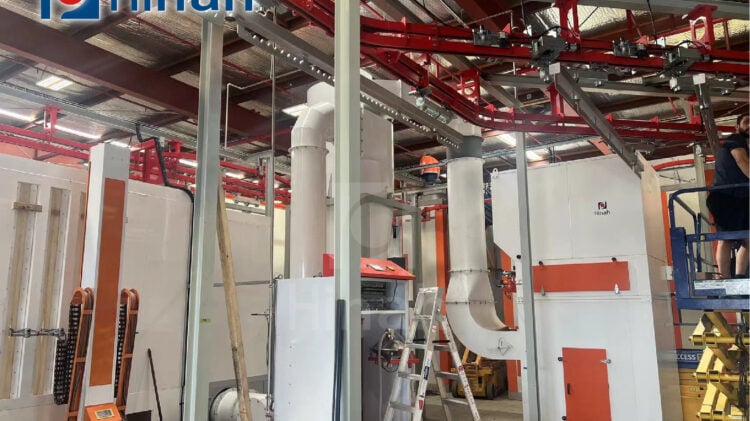
It also helps connect different equipment, such as spray booths, ovens, and pretreatment systems, into one coordinated process.
What Should You Consider Before Choosing Conveyor System?
Choosing between a monorail conveyor and a power and free conveyor system depends on your actual production needs.
Before making a decision, consider the following factors:
Product characteristics
The size, weight, and shape of workpieces affect the conveyor design. Heavy or irregular products may require stronger carriers and more flexible movement control.
Process requirements
Check whether different stages require different waiting times. If some processes need longer treatment periods, independent carrier movement becomes more important.
Factory layout
The available space and production route also influence conveyor selection. Complex layouts often benefit from a system that can support different movement paths.
Future production changes
A conveyor system should not only match current requirements. It should also allow adjustments when product types or processes change.
Last Words
There is no single answer for every coating line.
A monorail conveyor is suitable for simple, continuous transportation where all products follow the same process.
A power and free conveyor system is better suited for applications that need more flexibility, better control, and independent carrier movement.
For powder coating and other finishing processes, the right choice depends on the complexity of your production flow. If your line needs accumulation, different processing times, or more control between stations, a power and free design can provide a more practical solution.
Understanding the difference between these two conveyor systems helps you choose a setup that matches your coating process instead of limiting it.