How to Recover Exhaust Heat from a Powder Curing Oven?
Every powder curing oven continuously rejects heat through its exhaust system. This airflow is necessary because the oven must remove moisture, combustion by-products, and contaminants generated during production.
However, the exhaust stream often leaves the oven at temperatures ranging from 120°C to 200°C. In many facilities, this heated air is discharged directly outdoors even though it still contains a large amount of usable thermal energy.
The challenge is not finding the heat. The challenge is recovering it without affecting curing consistency, airflow balance, or product quality.
To understand how exhaust heat can be reused, it is important to first examine where the heat comes from and how it moves through a powder curing oven.
Where Does Exhaust Heat Come from in a Powder Curing Oven?
During the curing process, a powder curing oven transfers heat from the heating system to coated parts through controlled air circulation. Gas burners or electric heating elements provide the required thermal energy, while circulation fans distribute hot air throughout the chamber.
At the same time, part of this heated air must leave the oven through the exhaust system. This process prevents the accumulation of moisture, volatile substances, and combustion gases.
The exhausted air usually contains heat from several sources:
- Hot circulating air leaving the curing chamber
- Heat generated during fuel combustion
- Warm air removed during ventilation
- Thermal energy carried by exhaust gases
Although this heat is no longer directly involved in curing, it can still be reused through a properly designed recovery system.
How Does Exhaust Heat Recovery Work?
The basic principle of heat recovery is transferring heat from the exhaust stream to another air stream.
Most systems use a heat exchanger installed between the oven exhaust outlet and the fresh air supply system.
Inside the heat exchanger, hot exhaust air flows through one channel while cooler incoming air flows through another. The two air streams remain separated, but heat passes through the exchanger surface.
The preheated fresh air then enters the oven, reducing the temperature difference between incoming air and the required curing temperature.
This process allows the oven heating system to operate under more stable conditions while maintaining the original curing parameters.
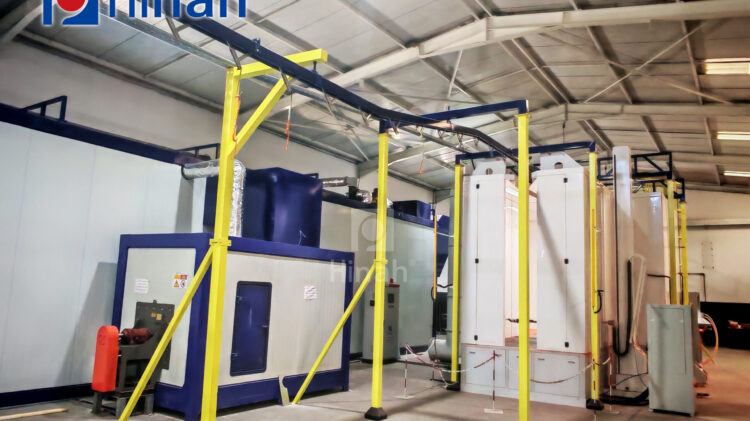
Using Heat Exchangers for Powder Curing Oven Applications
Different heat exchanger designs are available for industrial coating systems. The right choice depends on exhaust temperature, airflow conditions, and contamination levels.
Plate Heat Exchangers
Plate heat exchangers use multiple metal plates to create a large heat transfer area.
They provide efficient heat exchange within a compact structure. They are suitable for applications where exhaust air contains limited contaminants and regular cleaning is possible.
Tube Heat Exchangers
Tube heat exchangers are commonly used in harsher industrial environments.
Their structure allows easier inspection and cleaning, which is important when powder particles or other residues may enter the exhaust system.
Rotary Heat Exchangers
Rotary heat exchangers use a rotating heat transfer wheel to exchange thermal energy between exhaust air and fresh air.
They can provide high heat transfer performance, but they require careful control to prevent cross-contamination between air streams.
Before selecting a heat exchanger, engineers should evaluate the actual operating conditions of the powder coating line rather than choosing equipment based only on heat transfer capacity.
Factors That Affect Heat Recovery Performance
Recovering exhaust heat depends on more than the temperature of the exhaust air.
Several factors influence the final performance:
Exhaust Temperature
Higher exhaust temperatures usually provide greater recovery potential. However, extremely high temperatures may require additional protection for heat exchange components.
Airflow Volume
The amount of exhaust air directly affects available thermal energy. A small airflow with high temperature may provide less recovery potential than a larger airflow with moderate temperature.
Oven Operating Conditions
Production speed, part size, coating thickness, and curing temperature all influence airflow requirements.
Because these conditions change during production, engineers should analyze actual operating data before designing a recovery system.
Why Air Balance Is Critical During Heat Recovery?
A powder curing oven depends on precise airflow control.
The exhaust system cannot simply be reduced to capture more heat. Excessive changes in exhaust volume may affect pressure balance inside the oven.
Incorrect airflow settings can lead to:
- Uneven temperature distribution
- Longer curing time
- Poor coating appearance
- Reduced process stability
Therefore, heat recovery should always work together with the oven ventilation system.
A successful design recovers available heat while keeping air movement inside the curing chamber within the required range.
Common Problems in Exhaust Heat Recovery Systems
Some heat recovery systems lose performance after installation because of incorrect planning.
One common issue is insufficient consideration of exhaust conditions. If the exhaust contains dust, oil mist, or powder particles, heat exchanger surfaces may become contaminated over time.
Another issue is limited maintenance access. A system that cannot be inspected or cleaned easily may experience reduced heat transfer performance.
For industrial coating applications, reliability and maintenance convenience are just as important as initial heat transfer performance.
Conclusion
Every powder curing oven releases a continuous stream of heated exhaust air during operation. Instead of allowing this thermal energy to leave the facility unused, manufacturers can recover it through properly designed heat exchange systems.
The key to successful exhaust heat recovery is maintaining the balance between heat transfer and curing performance. Engineers must consider exhaust temperature, airflow volume, heat exchanger design, and oven air balance together.
When these factors are carefully evaluated, recovered exhaust heat can become an effective part of a modern powder coating system while keeping the curing process stable and consistent.