The Key Factors That Decide Your Powder Coating Line Speed
The speed of powder coating line is never just a number on the conveyor display—it’s the heartbeat of the entire production flow. The pace at which each workpiece moves from pretreatment to curing determines not only how much you can produce in a day, but also how stable and consistent your coating quality will be. Too fast, and defects begin to surface; too slow, and efficiency drops along with your energy savings.
Finding the right line speed is really about understanding what limits it. Among all the variables in the coating process, a few critical factors ultimately decide how fast the line can run without compromising finish quality. These factors shape the balance between productivity and precision—and knowing them is the first step to optimizing your powder coating performance.
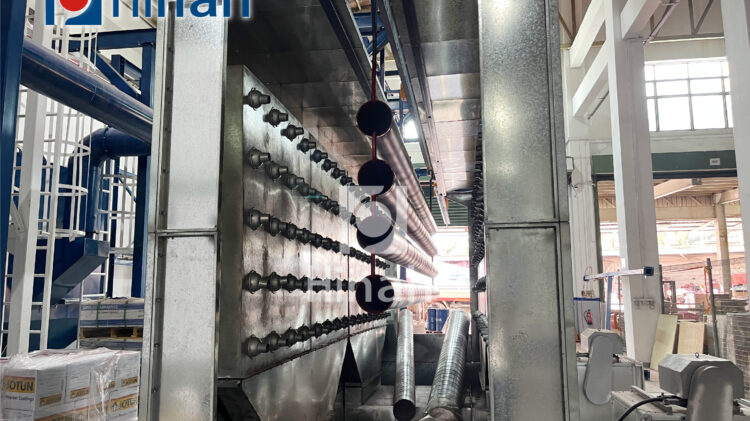
Curing Requirements: The Non-Negotiable Speed Limiter
When it comes to line speed, the curing process sets the rules—and those rules don’t bend. Powder coating relies on a precise combination of temperature and time to fully crosslink the powder into a durable finish. For many powders, curing at around 200°C requires roughly 15–20 minutes of dwell time in the oven.
This means the conveyor cannot run faster than the curing window allows. If the line moves too quickly, the parts simply won’t stay in the oven long enough. The result is under-cured coating: soft film, weak adhesion, and a finish that fails long before it should. Slowing the line too much isn’t a solution either. While longer dwell times guarantee full curing, they also drive up energy consumption and reduce overall throughput. The goal is to match oven length, temperature stability, and coating thickness so the line runs at the fastest speed that still ensures a fully cured, reliable finish. In most cases, curing becomes the primary factor that defines how fast the entire powder coating line can truly go.
Workpiece Complexity and Coating Thickness
Not all parts move through a powder coating line the same way. The shape, size, and geometry of each workpiece directly influence how fast the conveyor can run. Simple flat surfaces can be coated quickly and evenly, but complex parts—those with deep recesses, sharp corners, or tight angles—require more careful coverage. Spray guns need additional dwell time to reach difficult areas, and operators may need to adjust technique or spray angles to avoid thin spots or Faraday cage effects. All of this slows down the pace the line can safely maintain.
Coating thickness adds another layer of limitation. Thicker films demand more powder during application and naturally require longer curing times in the oven. Even if the spraying stage can be completed quickly, the extended curing time forces the entire line to operate at a slower speed to prevent under-cure.
When production involves a mix of different parts, the most challenging piece often dictates the overall speed. Large items, irregular shapes, or products that require heavy coating buildup reduce the conveyor speed ceiling. As a result, understanding the physical characteristics of each workpiece—and how they interact with your coating requirements—is essential for setting a realistic and stable line speed.
Pretreatment Efficiency and Process Bottlenecks
Long before powder ever touches the metal, the pretreatment line has already decided how fast the entire system can run. Every stage—degreasing, rinsing, phosphating, and drying—must be completed properly, and each of these steps has a fixed process time. If one section requires ten minutes for the chemistry to work, the conveyor simply cannot move faster than that. Otherwise, the coating will be applied onto a surface that isn’t fully cleaned or prepared, leading to adhesion problems that no amount of curing can fix.
Pretreatment is often the quiet bottleneck of many powder coating lines. Unlike spraying or curing, where issues are immediately visible, pretreatment problems show up later as peeling, blistering, or rust creep. When the line speed outruns the pretreatment process, defects become inevitable and costly.
A well-balanced line matches conveyor speed with the slowest pretreatment stage, ensuring each part moves only when the surface is truly ready for coating. Synchronizing spray zones, rack design, tank length, and drying time prevents backups and keeps the process flowing smoothly. In many facilities, fine-tuning pretreatment efficiency is the key to unlocking higher line speeds without sacrificing coating reliability.