Axle Dip Painting Line in Germany: Film Build and Drainage
On an axle dip painting line, the part leaves the tank covered in wet paint. The next ninety seconds decide whether it passes inspection. Paint drains off the shaft and collects at the flange. It also leaves a mark where the hanger touched it. A spray line can touch up these defects after curing. A dip line cannot hide them. Whatever sits on the part when it enters the oven becomes the coating the customer receives.
Three variables decide yield: film build, drainage and hanger design. They interact. Change one, and the defect usually moves somewhere else. The notes below come from a recent axle project in Germany. Film thickness records and appearance criteria both went into the acceptance test there.
What does a dip painting line do that spraying cannot?
An axle is an awkward shape for a spray gun. The shaft is long and round. The flange has a face and a rim. Welded brackets create corners that stay in shadow. A reciprocator coats the outside of the shaft well. It coats the bracket undersides badly. Spray lines for axles therefore depend on operators to reach the shadowed areas by hand. Immersion removes that dependence. Every surface below the paint level meets liquid paint at the same moment. That includes weld toes, the inside of the flange rim and the shaded side of a bracket.
Powder dip usually runs as a fluidized bed. It heats the part and dips it into aerated powder. The process builds a thick single layer and suits mesh, wire and simple sections. Dip painting uses liquid paint at ambient temperature and cures the film in an oven. Electrocoating adds a direct current and a conductive part. It gives the tightest film control of the three. It also needs a longer pretreatment chain and a tank the team must keep in balance every shift. The choice between them depends on tolerance, volume and part geometry. It does not depend on which process sounds more advanced.
All three processes fail the same way when pretreatment is weak. A dip tank cannot compensate for oil left on a forging. Paint will not bond to a surface without a conversion coating. Design the pretreatment section with the same care as the paint tank itself. A defect that starts in degreasing shows up as adhesion loss three stages later.
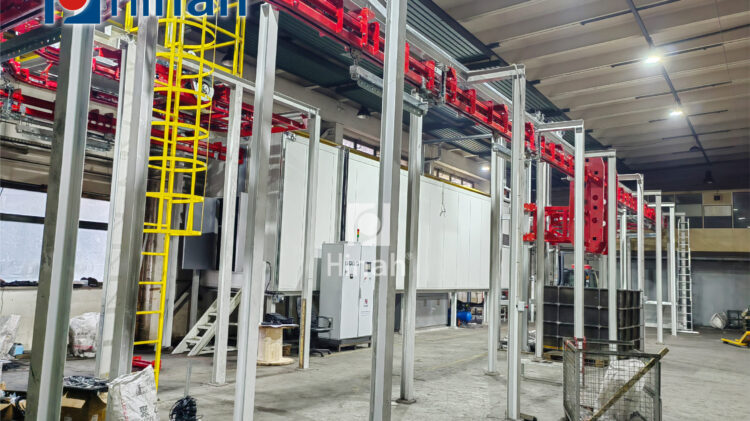
Why does film build differ between the shaft and the flange?
Three variables set film thickness on a dipped part. They are withdrawal speed, paint viscosity at that moment, and how the surface drains. Withdrawal speed is the one the line controls directly. Pull an axle out quickly and the film stays heavy. Pull it slowly and the paint has time to run back into the tank, leaving a thinner film. On a long shaft the two ends leave the tank at different moments. A single withdrawal speed therefore produces a gradient along the part.
Geometry does the rest. A flange face that sits horizontal when the axle leaves the tank holds a puddle. The same flange standing vertical drains cleanly, but it can show runs along the rim. Neither position is wrong on its own. The mistake is fixing the orientation for handling convenience. Then teams try to correct the film with paint viscosity. A viscosity change moves the whole part rather than one area. It also alters drainage behaviour that was already acceptable.
Where should film build be measured on a dipped axle?
Measure film build at defined points, not wherever the gauge happens to land. On an axle, three points cover most of the risk. They are both ends of the shaft and one point on the flange face. Measure by the method in ISO 2808 to keep the numbers comparable between shifts. Record the readings by hanger position, and a coating result becomes a line setting you can adjust.
German acceptance tests tend to treat film build as a record, not a reading. One gauge value from a sample part is not enough. The drawing names the measuring points. The report has to show those points across a run, tied to hanger position and oven load. The requirement is as much documentation as coating. It is far easier to meet when the measuring points go into the hanger drawing. Adding them after commissioning costs time. On an axle dip painting line in Germany, the paperwork is usually agreed before anyone signs off the tank layout.
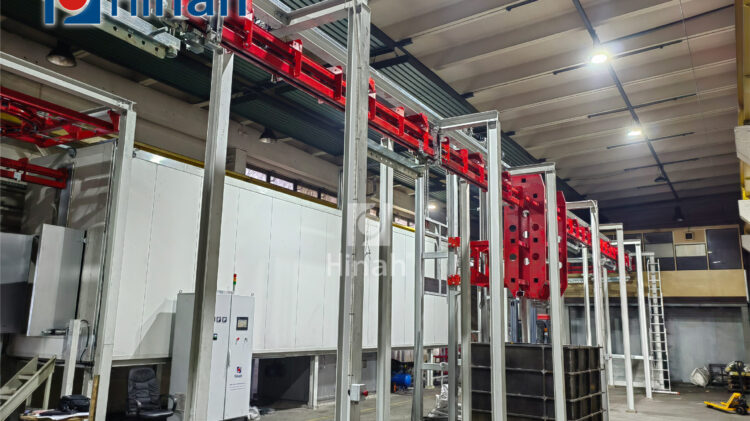
Where does paint pool after the axle leaves the tank?
Paint keeps moving after the part leaves the tank. It collects at the lowest point of every surface. On an axle those points are predictable. They are the thread and shoulder at the spindle end, the radius where the flange meets the tube, the toe of a weld, and any blind hole left unplugged before dipping.
Pooling is a curing problem before it is an appearance problem. A thick pocket of paint skins over in the oven while solvent or water stays trapped underneath. The film then blisters or stays soft. On a bearing seat or a brake mounting face, the same pocket becomes an assembly problem. The paint has to come off before the part fits. Removing it by hand is where coating damage starts.
The fix is time and orientation, not more paint control. On the line, the drainage zone between tank and oven is a designed station. It is not spare floor space. It lets the part hang long enough for the heaviest area to stop dripping. A controlled tilt or rotation during that pause moves the last of the liquid away from critical surfaces. Mask machined faces and threads before dipping. Masking after curing means cutting cured paint, which is slower and always leaves an edge.
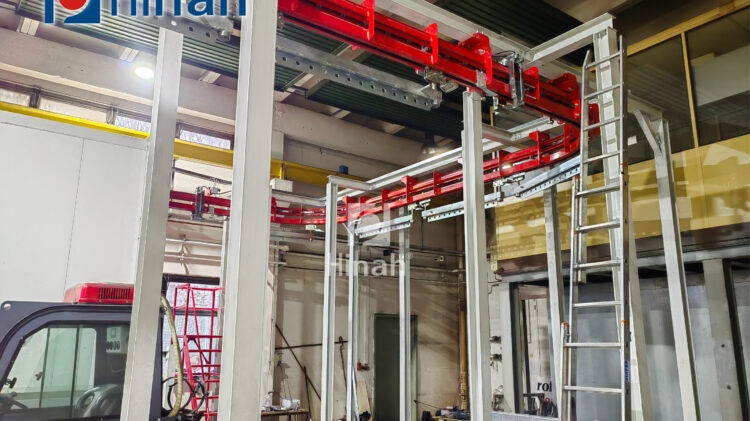
How should hangers be designed so the marks land outside the coating area?
Every dipped part hangs from something, and no paint reaches the contact point. On an axle the hanger should grip a machined surface or an area allowed to stay bare. The bare spot then becomes a drawing requirement instead of a defect. Gripping the shaft because it is the easiest place to hold is the most common reason a finished axle fails a visual check.
Load path matters as much as contact location. An axle is heavy relative to its length. A single-point hanger lets it hang out of level, which changes how paint drains along the tube. Two support points spread along the shaft keep the part level. They also reduce sway on a moving conveyor. The hanger has to stay straight as well. A bent arm changes the gap between parts and the angle of the flange. Both show up as film variation that looks like a paint problem.
Hangers accumulate coating, and that buildup changes the contact area with every cycle. A hanger that starts as a point contact becomes a patch after a few hundred parts. The bare area then grows until it reaches a surface that needs coating. Strip hangers on a fixed interval and record that interval. The record keeps the mark size under control. It is a maintenance setting, not an operator preference.
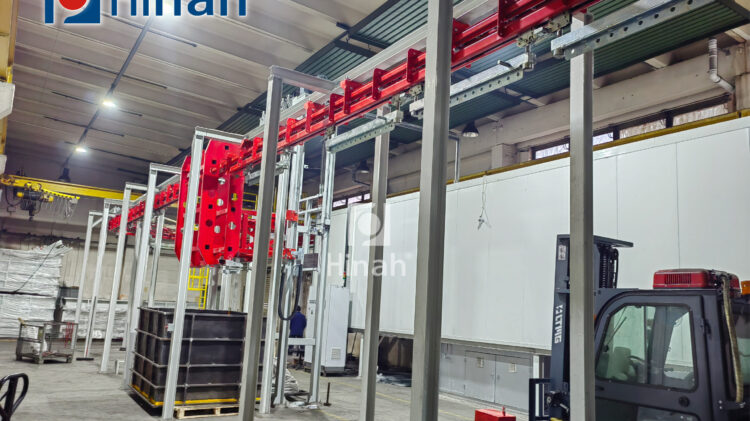
What changes when axles run on a continuous conveyor?
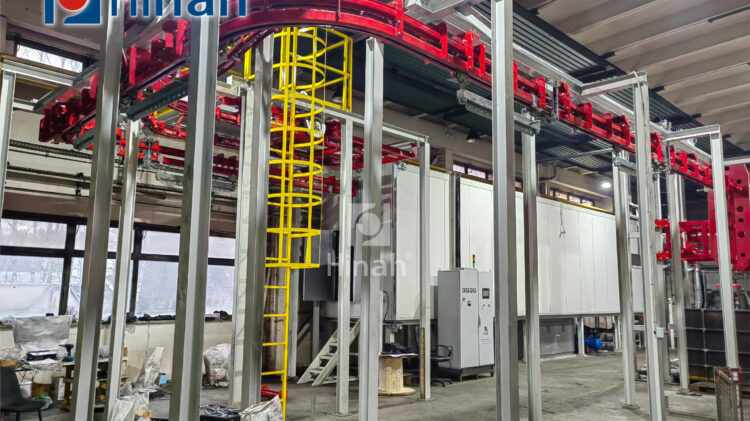
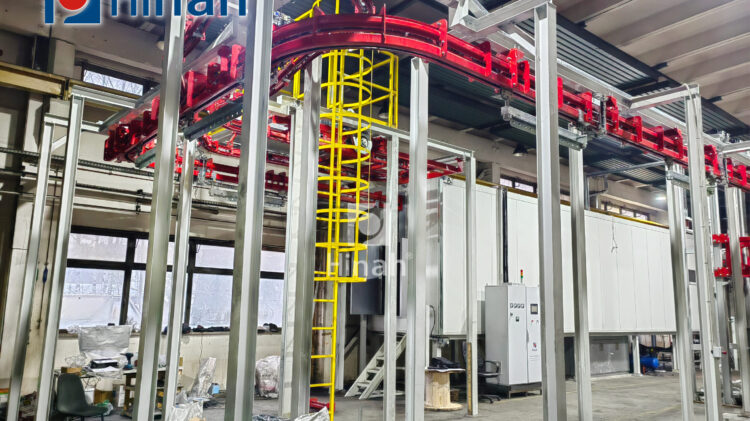
Moving from a batch dip to a continuous conveyor changes how you set dwell time. In a static tank the operator controls immersion with the hoist. On a conveyor, dwell time is the immersed tank length divided by line speed. That makes line speed a process parameter, not a throughput target. Agree the number before the tank is built. Do not tune it afterwards.
The layout also needs an accumulation section. Axles drain at different rates depending on size and on their position in the batch. A conveyor running at one fixed speed forces the fastest-draining part to set the pace for the oven. A power and free conveyor section between the tank and the oven lets parts pause for drainage without stopping the line. It also lets a slow-draining axle take the extra minute it needs.
Curing closes the loop. The paint supplier fixes the oven dwell a given film needs, so oven length and conveyor speed move together. A line that cannot hold that combination will either under-cure the heaviest film or over-cure the thinnest part. Loading and unloading stations belong in the same calculation. The operator’s cycle at each end limits what the middle of the line can do.
Which checks catch a drainage problem before curing?
Wet-film inspection is the cheapest control point on the line. It is also the one most often skipped. A light check at the exit of the drainage zone catches pooling at the flange radius and runs under the shaft. Catch them there and they never become a rework job. Wet-film thickness gauges give a rough number, but the eye is faster at spotting a drip that has started to skin over.
After curing, three checks cover most acceptance criteria. The table below shows what each one proves and when to run it.
| Check | Standard | What it proves | When to run it |
|---|---|---|---|
| Dry film thickness | ISO 2808 | The line holds the specified range across shaft and flange | Every hanger position, each shift |
| Cross-cut adhesion | ISO 2409 | Pretreatment and curing are both in order | Start of run and after any pretreatment change |
| Salt spray | ISO 9227 | The film will survive service | Qualification and process changes, not routine release |
The last check is bookkeeping. Record film thickness, adhesion results and defect type against hanger position and oven load, not only against the date. Once those three fields sit in the same row, a recurring flange blister points to a drainage setting instead of a paint batch. The next shift can then correct it before another hundred axles run.
Conclusion
An axle dip painting line rewards a design built around drainage. The tank is the simple part. Withdrawal speed, hanging position, the pause before the oven and the conveyor decide whether film build stays inside tolerance. Setting those four points is cheaper than adding inspection. It is the difference between a line that runs to a drawing and one that runs to whatever the operator learned. In Germany the drawing is only half of it. The measurement record that proves the drawing was met travels with the parts.
If you are specifying an axle dip painting line, send the part drawing and the coating specification. The geometry tells us more about the line than the throughput figure does.